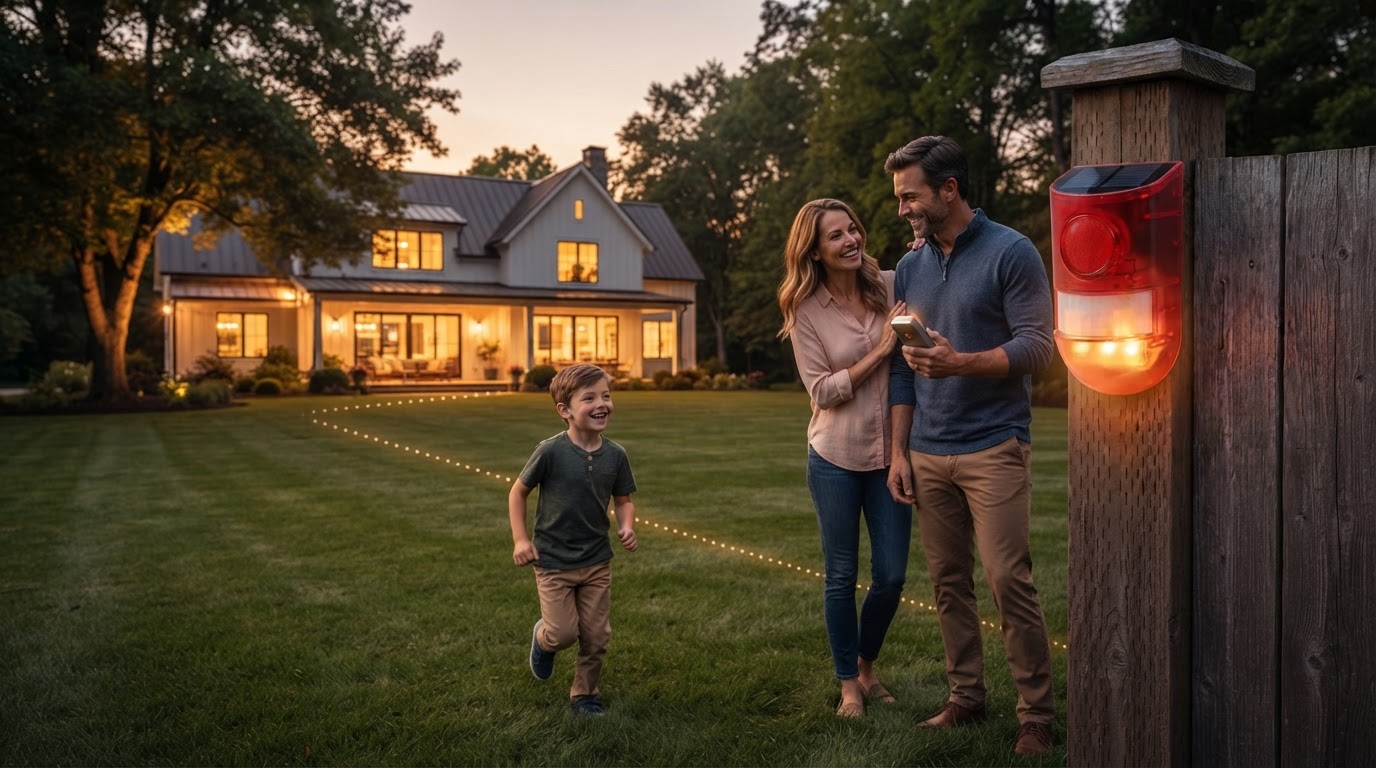
How to set up a Solar Motion Alarm perimeter?
 Maya ChenContributing Editor
September 21, 2026 — Setting up a Solar Motion Alarm perimeter requires precise alignment of dual-beam sensors and a clear line of sight to a central receiver, typically covering distances between 1,000 and 3,000 feet depending on the specific hardware kit selected.
Property owners often seek these systems to secure large acreage or remote driveways where trenching power lines is cost-prohibitive. The conventional wisdom says that more sensors always equal better security, but a poorly planned perimeter actually creates a noise-to-signal ratio that renders most alerts useless.
How far can a Solar Motion Alarm perimeter reach?
A standard Solar Motion Alarm perimeter can span up to 3,000 feet between the sensor and the receiver, provided there are no significant topographical obstructions. While many consumer-grade PIR sensors struggle past 30 feet of motion detection, perimeter-specific beam systems are designed for long-range communication back to the base station. Ultra Secure USA notes that their DA600+ Wireless Security System maintains a reliable connection at 2,700 feet, using solar-powered beams to bridge the gap without external wiring. Run the math: for a square 10-acre lot, you aren't just looking for sensor range, but the wireless penetration through foliage and structures. If the receiver is tucked behind a brick wall, that 2,700-foot rating effectively drops by 30-40%.
Does solar positioning affect perimeter reliability?
Solar positioning is the single most frequent point of failure in perimeter setups, as sensors must maintain a battery charge sufficient to power both the infrared beams and the wireless transmitter during 14-hour winter nights. Here's the part nobody talks about: a sensor placed in a shaded tree line will likely fail within 72 hours of overcast weather, regardless of its "solar" branding. According to Jansen Electronics, the Xtralert system requires a wireless range of over 1,000 feet under ideal conditions, but those conditions assume the solar panel receives at least 4 hours of direct UV exposure daily. To ensure reliability, sensors should be mounted on south-facing posts with a 15-degree tilt. I'll change my mind when solid-state batteries become standard in these units, but until then, the system is only as good as its last clear sunny day.
Quick answers
Q: Can the perimeter alarm work through heavy rain or fog? A: Most high-end systems, like the DA600+ infrared beam kits, use dual-beam technology to prevent false alarms from heavy rain, but dense fog can reduce the effective detection range by up to 50% due to infrared scattering.
Q: How many sensors can be added to one Solar Motion Alarm system? A: Most receivers, such as the 4-Channel Indoor Receiver, support up to 4 distinct zones, though some commercial configurations can manage 32 or more individual solar sensors.
Q: What is the lifespan of the internal battery in a solar perimeter sensor? A: The rechargeable lithium-ion or LiFePO4 batteries typically last 3 to 5 years before the chemical capacity degrades enough to require a manual replacement.
Q: Does the alarm require a Wi-Fi connection to function? A: No, professional perimeter systems like the Solar Motion Alarm typically use 433MHz or 868MHz radio frequencies to communicate directly with a local receiver, operating independently of the internet.
For further technical details, explore how remote operation with the Solar Motion Alarm system enhances site management, or read about securing property with Solar Motion Alarm strobe systems for visual deterrence. Understanding how the Solar Motion Alarm works for property security is essential before finalizing your hardware layout.
Learn more about Solar Motion Alarm at https://solarmotionalarm.com.
Sources
- Long Range Solar Powered Wireless Perimeter Alarm (2700 ft)
- Solar Powered Perimeter Detection - Jansen Electronics
- Secure Your Property with 3000ft Wireless Perimeter Alarms